
Sound familiar?
Tuesday, 10:15 a.m. You need five hours of focus. You get two.
You put on the usual lo-fi. Fifteen minutes later you're bored. The neighbor starts drilling, so you switch to rock with lyrics and start singing. You grab your phone “for a second” — and it's 11:05.
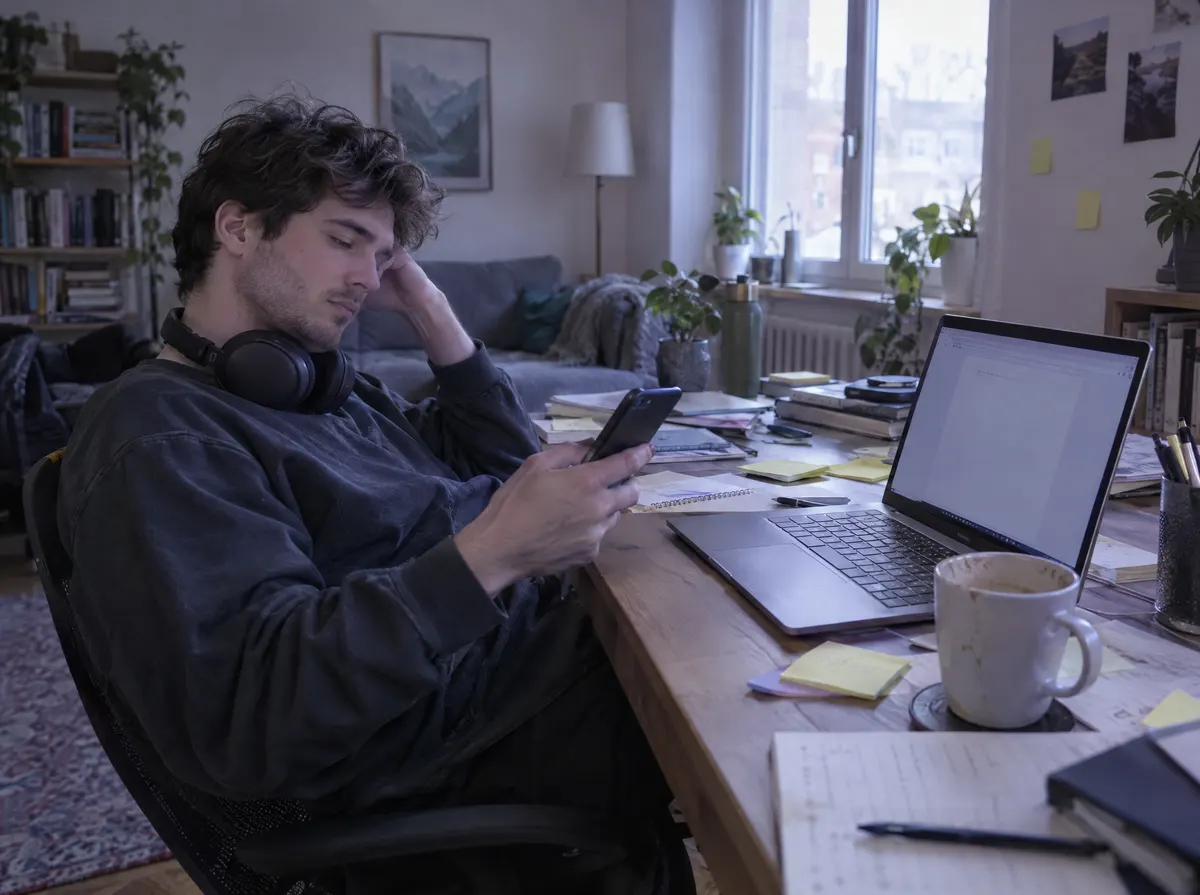
Binaural beats give me a headache.
Twenty minutes in and the headphones come off.
Lo-fi doesn't do it for me anymore.
Same playlist, every day. Your brain tunes it out.
I can't work with lyrics, I end up singing.
Your favorite rock playlist pulls you out of the zone.
I sit down to work and 10 minutes later I'm on TikTok.
Two hours in, the task is still on line 1.
13 min
The average focused work session in 2025, according to ActivTrak.
~23 min
To get your focus back after an interruption, as measured by Gloria Mark (UC Irvine).
What everyone tells you
“Just put on lo-fi or binaural beats.”
- Two styles, the same ones on every Spotify and YouTube playlist
- One frequency on loop for 8 hours
- A single track made for everyone
What actually works
Sound diversity + your own combos.
- Any music without vocals, for every taste
- The wave that works for you — binaural, isochronic or monaural
- Layered together, so each sound does its job
The Flow Mix Method
Your music + your wave + your shield
Three layers, one tap. Each sound does one job — together they keep you in the zone longer than any of them alone.
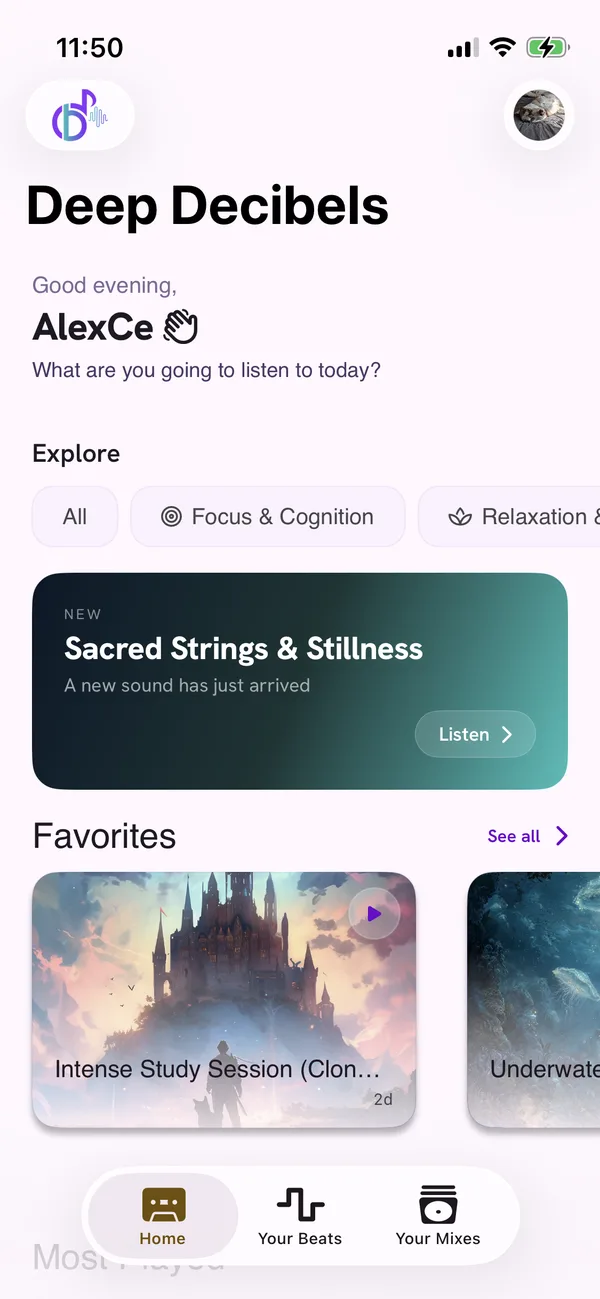
Layer 1
Your music
Any genre without vocals — rock, metal, classical, cumbia, lo-fi. You don't give up the music you actually like.
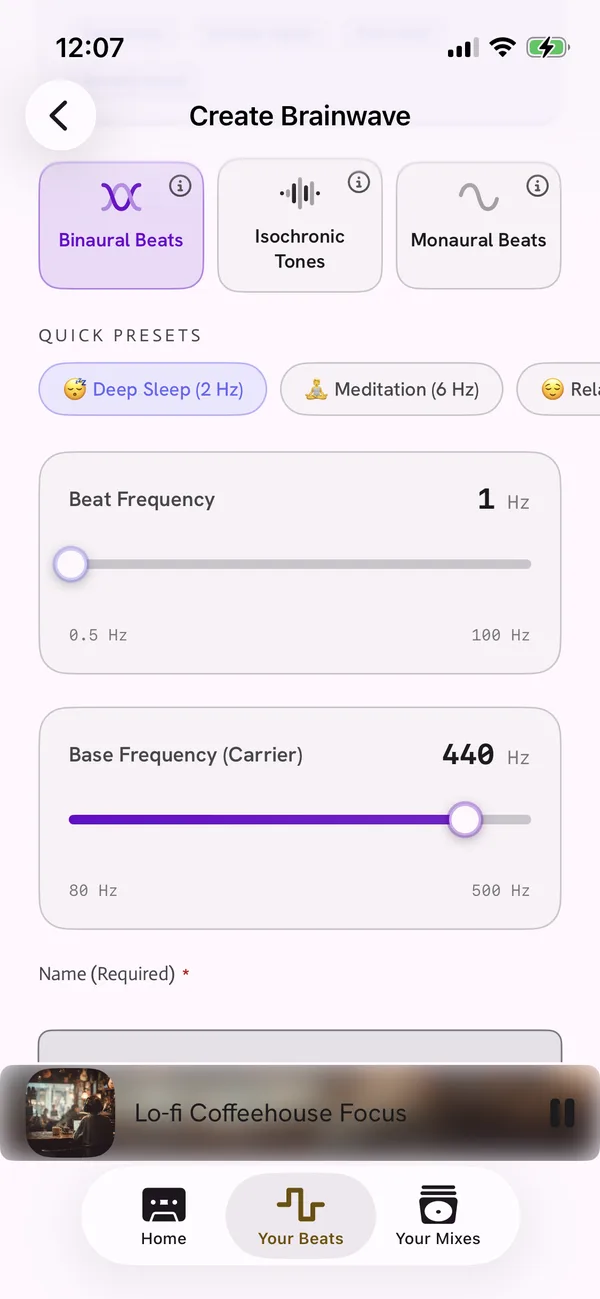
Layer 2
Your wave
Create your own binaural, isochronic or monaural beat and play it under your music. You never have to listen to it alone.
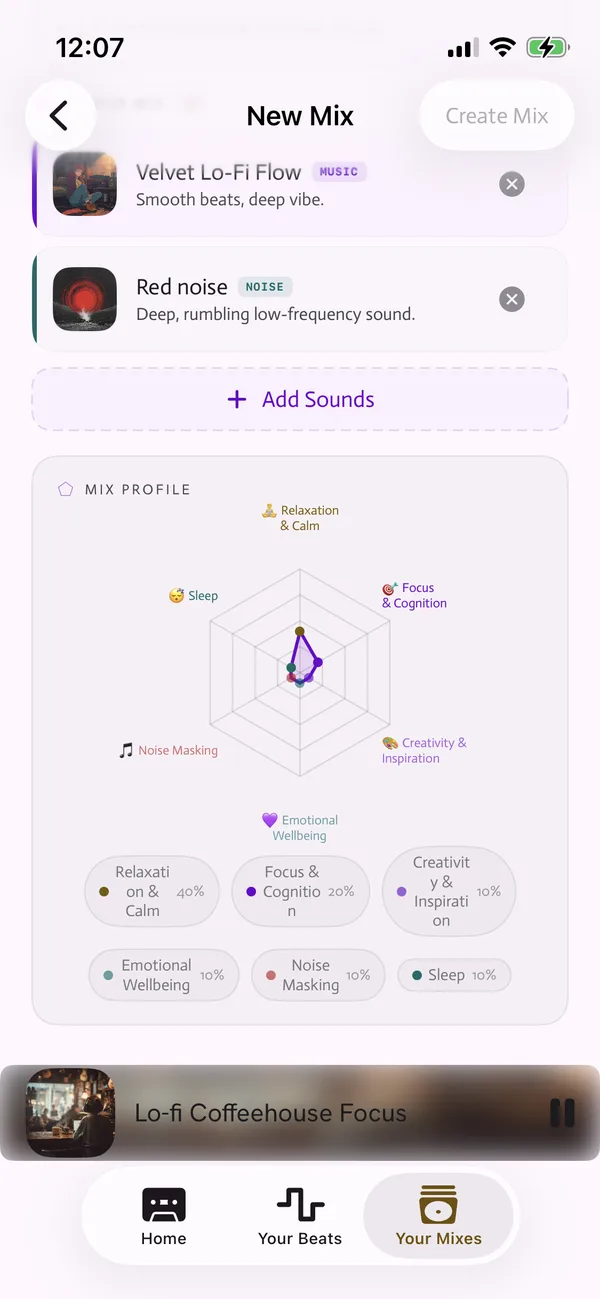
Layer 3
Your shield
Red, brown, pink or white noise — or rain, a fireplace, a coffee shop — to cover the neighbor's drill and the open office.
Build your first Flow Mix in 10 seconds
Pick one option per layer. There's no “right” combo — rock + red noise works for some people, classical + gamma for others.
Layer 1
Your music
Layer 2
Your wave
Layer 3
Your shield
Your Flow Mix
Rock without vocals + Binaural · Beta + Red noise
- ♪ the guitars you love, minus the lyrics
- ∿ for active focus (headphones)
- ◈ deep rumble that hides the drill upstairs
Build this exact combo in the app — or start from a ready-made mix and tweak the volume of each layer.
Every excuse has its piece
What you say
What solves it
What you get today
“Ten minutes in, I'm on TikTok.”
Flow Session: your mix + sleep timer
Your first 25-minute session today
“Lo-fi bores me.”
Layer 1 — music without vocals, many genres
Switch genres in one tap
“Binaurals tire my head.”
Layer 2 — your wave, under your music
Ready-made mixes with the wave already blended
“The noise at home won't let me focus.”
Layer 3 — your shield
Turn on red noise, mute the neighbor
“I don't know anything about frequencies.”
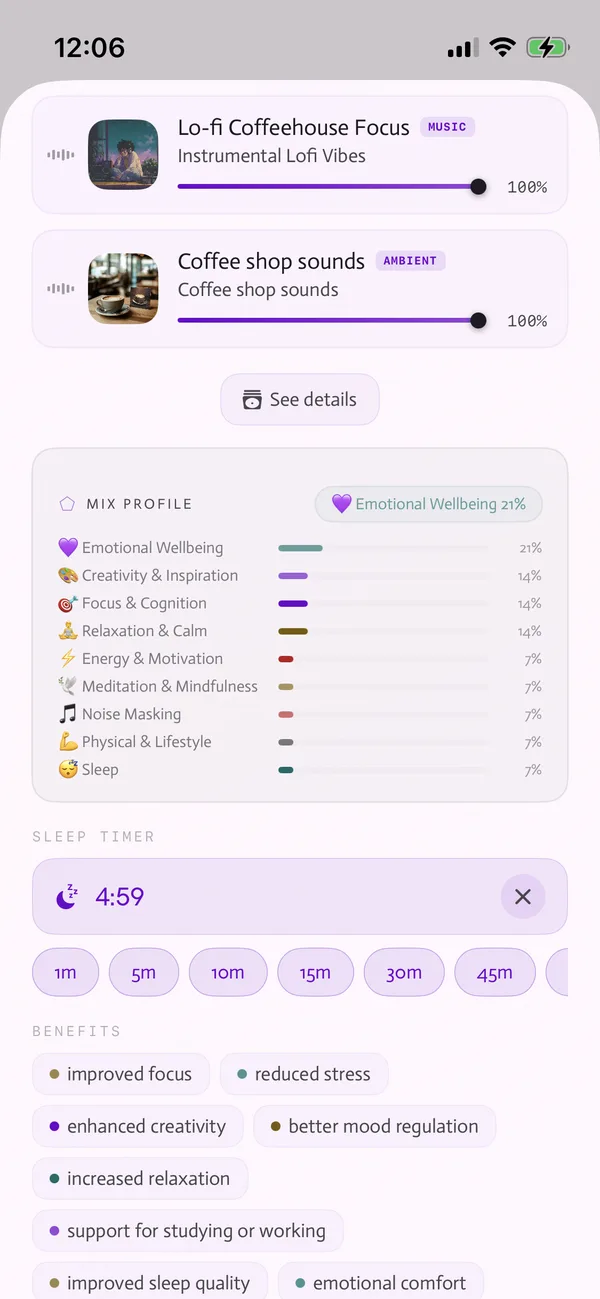
Ready-made mixes + the benefit of every sound on screen
Pick a goal, press play
“No internet, no music.”
Offline mode (Premium)
Download your Flow Mix
Why this exists
“Binaural beats gave me anxiety… so I programmed my own app.”
I'm Alejandro, a software engineer. I work 8 hours a day and I need at least 5 of real focus to get into flow.
Binaural beats helped me concentrate — but listening to them all day made me anxious. And every alternative was the same: lo-fi or binaurals, binaurals or lo-fi.
So I built Deep Decibels, my own sound engine for iOS and Android, to blend those waves with whatever music I wanted — rock, cumbia, anything — without vocals. It's what I use to stay focused through my workday.
If you're where I was: you're not bad at focusing. You were just given two options.
Start free. Upgrade when it clicks.
Press play without creating an account. Sign in with your email and you unlock 7 days of Premium — if you don't upgrade, you go back to the free plan. Nothing to cancel.
Free
Forever
- Sound library: music without vocals, ambient sounds, colored noise
- Ready-made mixes for focus, study, relaxation and sleep
- Learn what every sound does
No account needed.
Premium · Annual
$7.99
$19.99
USD for your first year · less than $0.67 a month
- Create your own binaural, isochronic & monaural beats
- Build and save unlimited Flow Mixes
- Listen offline — no data, no Spotify needed
- Sleep & session timer
- Every new sound and feature we ship
Try it free for 7 days first. Monthly plan also available. Prices may vary by country and are shown in your store's local currency.
Know your layers
What each sound actually does
No theory required — the app shows the benefit of every sound. But if you're curious, here's the short version.
Before you ask
Isn't it expensive?+
Try every Premium feature for 7 days first — the trial starts when you sign in with your email. If you decide not to upgrade, you simply go back to the free plan: nothing to cancel. And the annual plan is $7.99 USD for your first year, less than $0.67 a month.
Can I listen offline?+
Yes. Offline listening is included in Premium, so your Flow Mix works on a plane, in a café with bad Wi-Fi, or anywhere without data.
I already pay for Spotify / YouTube is free. Why this?+
Spotify and YouTube give you one track made for everyone. They don't let you strip the vocals from your rock, layer it with red noise, or put your own binaural frequency underneath. Deep Decibels is built for exactly that.
Binaural beats don't work for me.+
That's the point: they're not your only option and you never have to hear them alone. Blend a wave quietly under your music, switch to isochronic or monaural tones, or skip the wave entirely and just use music + noise.
Do I need headphones?+
For binaural beats, yes — each ear needs a slightly different tone. Isochronic and monaural tones, music and noise all work on speakers.
Is this a medical treatment?+
No. Deep Decibels is a focus and relaxation tool, not a medical device, and we don't promise to cure anxiety, ADHD or insomnia. We explain what each sound is and let you find the combination that works for you.